Accounting Software Matt Valentine•February 16, 2026
10 Best Rental Property Management Software: 2026 Guide
Matt Valentine•February 16, 2026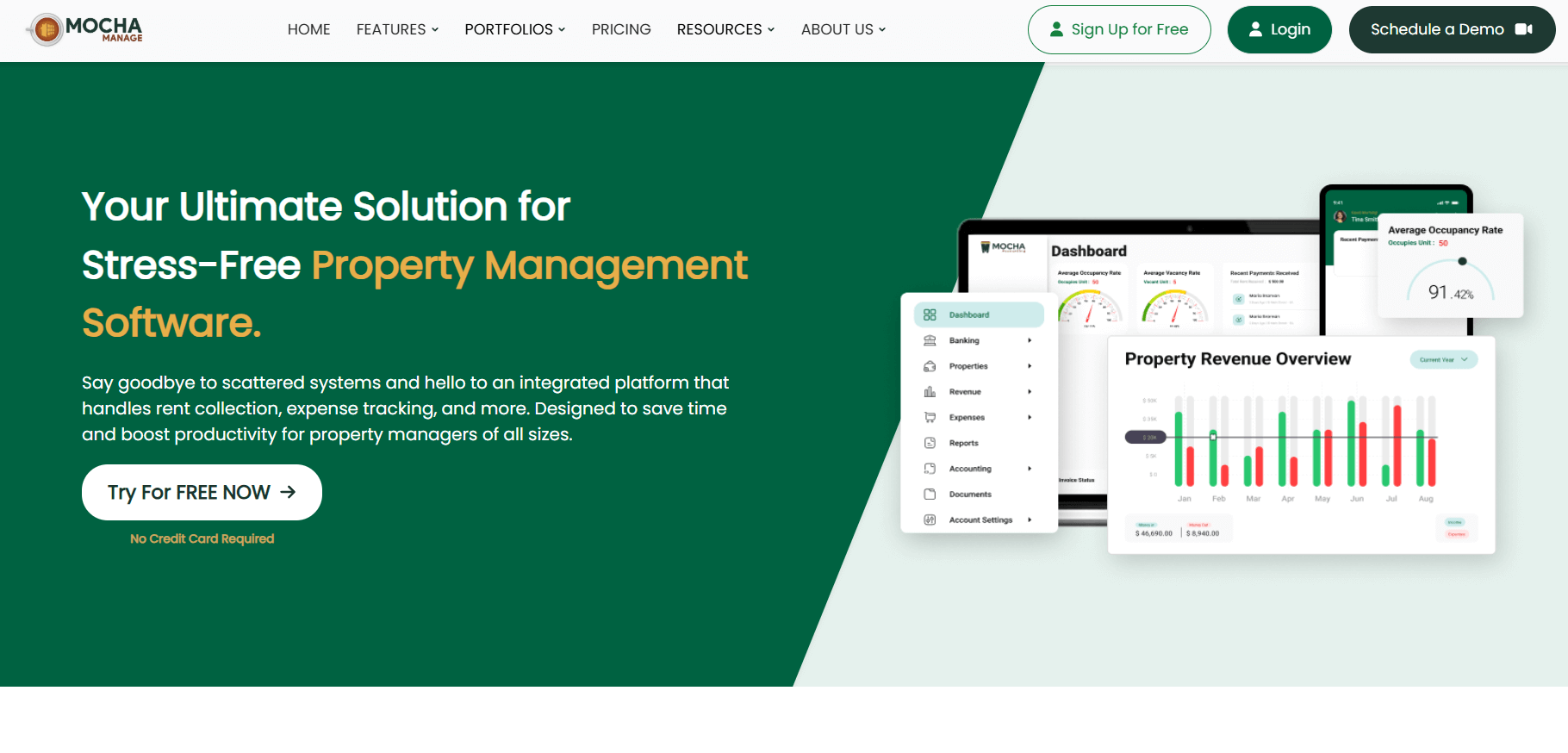 Matt Valentine•February 16, 2026
Managing rental properties means juggling a dozen things at once:
… And somehow keeping it all organized without losing your mind.
That’s what rental property management software is supposed to solve.
One platform that handles everything instead of five different apps, a spreadsheet, and a prayer.
But not all platforms are built the same. Some are great at leasing but weak on accounting. Others nail the financials but make tenant management an afterthought.
And some have so many features that their navigation becomes bloated and can barely get anything done (the irony).
This guide compares the 10 best rental property management software platforms in 2026, including our own all-in-one tool, Mocha Manage.
We’ll break down what each tool does well, where it falls short, and which one makes the most sense for your portfolio, depending on a variety of factors.
We looked at each platform across the areas that matter most when you’re actually managing properties day to day.
That includes:
Some tools lean more heavily toward certain areas than others. The goal is to help you find the right fit for how you actually manage properties.
Disclosure: The guide below includes our own property management tool, Mocha Manage.
Mocha Manage was designed by seasoned CPAs and property managers to deliver an experience that handles accounting, rent collection, maintenance, leasing, and communication in one platform seamlessly, without feature bloat or an overcomplicated navigation.
With that said, the guide below is meant to be as unbiased as possible and provide the software listed in a fair light so that you have several options to choose from.
Here are the 10 best rental property management software platforms, compared head-to-head.

Buildium is one of the most established names in property management software. It’s been around long enough that it’s become the default for many professional property managers.
You’d typically choose Buildium when you’re managing 50+ units and need something that handles everything from marketing vacancies to generating owner statements. Residential, commercial, HOAs—it covers all of it.
That maturity comes with depth. But it also comes with complexity that smaller landlords may not need, and the aforementioned feature bloat that users often mention makes getting simply things done harder than it should be.
Best For: Professional property managers with 20-200+ units
Essential plan starts at $58/month for up to 20 units. Growth plan at $183/month. Premium at $375/month. Pricing scales with portfolio size.

AppFolio is built for property management companies running hundreds or thousands of units.
It’s powerful, feature-rich, and designed for teams—not solo landlords managing a handful of properties. The platform handles residential, commercial, student housing, and community associations, and it’s been investing heavily in AI-powered automation.
If you’re managing 50+ units and need enterprise-grade tools, AppFolio is a serious contender. If you’re managing 10 units, it’s probably overkill.
Similar to Buildium, it also has issues with feature bloat if you’re a small to medium-sized landlord.
Best For: Large property management companies with 50+ units
Custom pricing (typically starts around $1.40-$3.00 per unit/month with a $250 minimum monthly spend). Contact their sales team for a quote.

DoorLoop positions itself as the modern, easy-to-use alternative to legacy platforms like Buildium and AppFolio.
The pitch? Professional-grade features without the complexity or steep learning curve. The interface is clean. Onboarding is fast. And you get the same core functionality that larger platforms charge significantly more for.
Having said that, it’s a newer platform with a smaller user base. Some landlords report that advanced features sometimes require add-on purchases.
Best For: Property managers with 10-100 units who want professional features without complexity
Starter plan at $99/month (max 10 units). Pro at $189/month. Premium at $239/month. Pricing increases after 20 units.

TurboTenant has built one of the most genuinely useful free plans in the market.
The free tier includes listing creation, tenant screening, rent collection, maintenance tracking, and lease management. That’s not a stripped-down teaser—it’s a functional property management platform at no cost.
The trade-off? Accounting features are more basic than dedicated platforms, and some landlords report slower rent deposit timelines than they’d prefer, which can be an outright dealbreaker.
Best For: DIY landlords with 1-100 units looking for free or low-cost management
Free plan available with core features. Premium plan at $149/year ($12.42/month billed annually) adds unlimited leases, e-signatures, faster payouts, and priority support.

TenantCloud offers a solid set of property management features at a price point that undercuts most competitors.
The platform covers listing, screening, leasing, rent collection, maintenance, and accounting—all in one place. It also includes separate portals for landlords, tenants, owners, and service professionals, which is a nice touch if your operation involves multiple stakeholders.
Keep in mind, though, that some of the deeper functionality (like advanced reporting or document storage) is limited on lower-tier plans.
Best For: Landlords with 1-75 units looking for affordable all-in-one management
Starter plan at $15.60/month (billed annually). Growth and Business plans available at higher tiers with expanded features.

Landlord Studio built their platform to be mobile-first.
That means the mobile app isn’t an afterthought—it’s the primary experience. If you manage properties from your phone while juggling a full-time job or traveling between units, that matters.
The platform pairs property management with strong accounting tools, including receipt scanning, automated bank feeds, and Schedule E report generation. It’s leaner than Buildium or AppFolio, but that’s intentional. Less complexity. Faster setup. Lower cost.
Best For: Landlords with 1-100 units who manage on-the-go
GO plan: Free (limited features). Starter: $15/month. Growth: $25/month. Professional: $35/month. All plans scale with unit count.

Rent Manager is the platform for property managers who want everything built exactly the way they work.
Highly customizable. Powerful. And designed for complex portfolios. The software covers accounting, leasing, maintenance, marketing, CRM, and more—and nearly every aspect of it can be configured to match your specific workflows.
The flip side? All that power comes with complexity. Setup takes time. Training takes effort. But for operations that need precision control over how things run, Rent Manager delivers.
Best For: Property managers with 200+ units who need deep customization
Custom pricing based on portfolio size and feature requirements. Contact their sales team for a quote.

Rentec Direct is built for landlords who self-manage their properties and need straightforward tools without enterprise complexity.
The platform handles accounting, rent collection, tenant screening, lease management, and maintenance tracking. It’s not flashy, and the interface feels a bit dated compared to newer competitors. But it gets the job done reliably and at a fair price.
If you want professional-grade tools without the overhead of platforms designed for large management companies, Rentec Direct hits a solid middle ground.
Best For: Self-managing landlords with 5-50 units
Rentec Pro (for landlords) starts at $55/month. Rentec PM (for property managers) starts at $65/month. Pricing scales with unit count.

Yardi Breeze is the simplified version of Yardi Voyager—the enterprise platform used by some of the largest commercial property management companies in the world.
It brings commercial-grade capabilities to smaller portfolios. If you manage commercial properties with complex lease structures, CAM reconciliation, and tenant billing, Yardi Breeze handles all of it. It also works for residential and mixed-use portfolios.
The Yardi name carries weight in the industry, and the platform delivers the reliability you’d expect. Having said that, it comes at a higher price point than residential-focused alternatives.
Best For: Commercial property managers with 5-100+ units
Residential Basic starts at $100/month ($1/unit additional). Residential Premier at $400/month. Commercial starts at $200/month. Affordable housing at $400/month.

Mocha Manage is purpose-built for property managers and HOA boards who need a platform that actually does everything it claims to do.
Not a maintenance app with basic bookkeeping tacked on. Not QuickBooks with workarounds. A genuine all-in-one platform where accounting, rent collection, leasing, maintenance, and communication work together from the start.
Here’s the difference with Mocha: it was built by property managers and CPAs who understood what was missing from existing tools. Too many platforms in this space offer a long feature list but fall short in execution—particularly on the accounting side. Mocha was designed to fix that gap.
Best For: Property managers with 5-50+ units, HOA boards, community associations

Mocha offers one of the most affordable plans on our list, coming in at just $1 per property with no minimums.
And unlike other property management tools, you get the lion’s share of features just from the basic plan.
That means you can pay as little as $1 for your first property, or even just up to $20 for a portfolio of twenty. Combined with the robust feature set comparable to long-term options, it offers the most all-around value.
So you’ve seen the options. Now what?
The truth is, the “best” software depends entirely on your portfolio size, your budget, and how you actually manage properties. Here’s how to think about it.
At this scale, you don’t need a ton of bells and whistles. You need basic rent collection, lease management, and expense tracking—probably not trust accounting or owner distributions.
Key features to prioritize:
This is where all-in-one property management software becomes critical.
You’re dealing with enough complexity that cobbling together separate tools creates more work than it saves. Mocha Manage is designed specifically for this range—full-featured enough to handle accounting, leasing, and maintenance, but not so enterprise-focused that it’s overwhelming.
Key features to prioritize:
You need industrial-strength software that can handle multiple owners, complex distributions, and detailed reporting. Look for platforms used by professional management companies with strong support and deep feature sets.
Key features to prioritize:
At enterprise scale, you need platforms designed for teams and complex workflows. For commercial properties, look specifically for software that handles CAM reconciliation, percentage rent, and complex lease structures.
Key features to prioritize:
HOA management has unique requirements. Assessment tracking. Violation enforcement. Reserve fund management. Board communication.
Look for platforms that handle these alongside standard property management features.
Key features to prioritize:
Before you commit to a platform, make sure it checks these boxes.
Collecting rent manually creates errors, delays, and unnecessary work. Your software should support ACH, credit card, and debit card payments with automated reminders and late fee enforcement. And payments should post to your accounting records automatically—no double entry.
Finding reliable tenants is the foundation of profitable property management. Your software should integrate with credit bureaus for background checks, credit reports, and eviction history—ideally without requiring a separate subscription or third-party tool.
From applications to e-signatures to renewals, your leasing workflow should live inside your management platform. Look for state-specific lease templates, document storage, and automated renewal reminders.
Tenants should be able to submit maintenance requests through a portal. You should be able to create work orders, assign vendors, track progress, and connect the costs to the right property in your accounting system. Bonus if you can communicate with vendors and tenants directly from within the platform.
Your software should track income and expenses by property and unit. It should generate P&L statements, balance sheets, cash flow reports, and owner statements. If you’re managing properties for third-party owners, trust accounting is a must.
Self-service portals cut down the back-and-forth. Tenants should be able to pay rent, view their lease, and submit requests. Owners should be able to access financial statements and property performance data without having to call you.
Whether it’s announcements, maintenance updates, or payment reminders, your platform should centralize communication. This keeps a record of all correspondence and means you’re not relying on personal email, texts, and phone calls to manage tenant relationships.
Vacancies cost money. Every month a unit sits empty, that’s lost income. Your software should help you create listings and syndicate them across major rental sites like Zillow, Apartments.com, and Realtor.com to fill units faster.
The right software changes how you manage properties.
Less time on manual tasks. Tenants pay on time. Maintenance requests get handled without falling through the cracks. And your financial records are accurate and audit-ready.
But too many property management platforms have become bloated with features you’ll never use. Confusing interfaces that require extensive training. Rigid systems that don’t adapt to how you actually work.
Mocha Manage was built to fix that.
Property accounting and management in one integrated platform. Built specifically for property managers, landlords, and HOAs. Clean interface. Powerful features. No QuickBooks workarounds needed.
Try Mocha Manage for free to see how it can simplify your rental property management.


