Property Management
Mileage Reimbursement for Landlords and Property Managers: A Complete Guide (2026)
Matt Valentine•August 23, 2026
## Key Takeaways
Mileage is a deduction a lot of landlords leave on the table each year.
Every time you drive to a property to check on it, meet a contractor, show a unit, pick up supplies, or drop a deposit at the bank, you're driving for business. And business driving is deductible. At 72.5 cents per mile for 2026, those trips add up fast.
The problem isn't that landlords don't know mileage is deductible. It's that they don't track it. And without a record, the deduction is either lost entirely or claimed on a shaky estimate that won't hold up if the IRS asks questions.
This guide covers how mileage deductions and reimbursement work, which trips qualify, the two methods for claiming the deduction, and how to track your miles so you never leave the deduction on the table again.
## Why Mileage Matters for Property Management
Property management involves a surprising amount of driving. Trips to properties for inspections and maintenance. Runs to the hardware store. Meetings with contractors, agents, and tenants. Trips to the bank. Drives to show vacant units.
Every one of those miles is a deductible business expense if you track it. And the deduction is meaningful.
Consider a landlord who drives 4,000 business miles a year managing their properties. At the 2026 rate of 72.5 cents per mile, that's a deduction of $2,900. For a landlord in the 24% tax bracket, that's nearly $700 in actual tax savings, just for tracking trips they were already taking.
The mileage deduction falls under the auto and travel category on Schedule E (Line 6), one of the categories we cover in our guide to [tracking rental income and expenses](https://mochamanage.com/resources/blogs/track-rental-income-expenses?utm_source=blog&utm_medium=internal_link&utm_campaign=mocha_manage_blog&utm_content=rental_income_tracking_blog_link). It's also one of the most commonly missed, precisely because it requires tracking that most landlords don't do.
## What Counts as Deductible Mileage
Not every mile you drive is deductible. The IRS distinguishes between business driving (deductible) and personal or commuting driving (not deductible).
Here's how the trips break down.
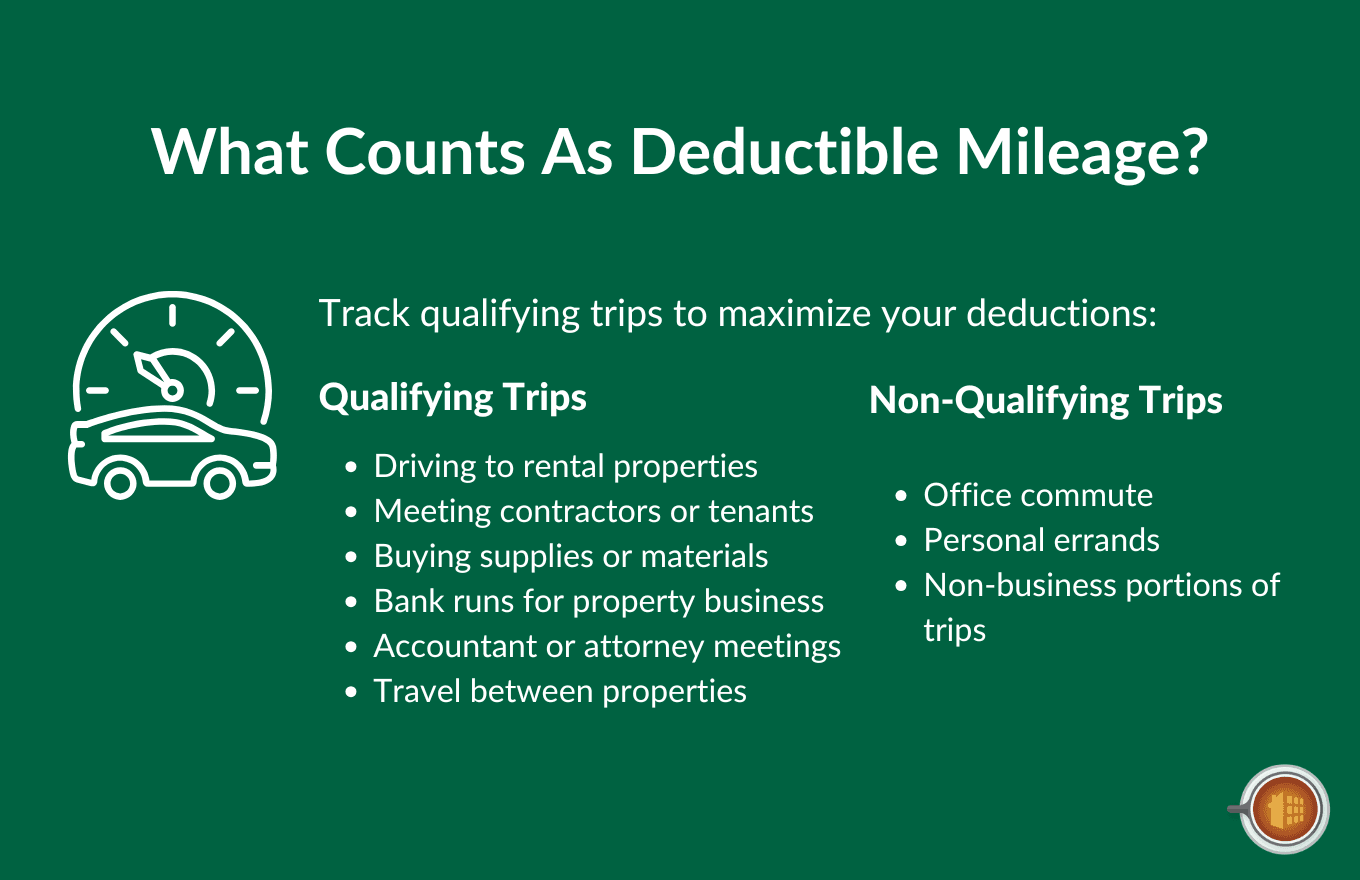
### Qualifying Trips
These are the property-related business trips you can deduct:
- Driving to your rental properties for inspections, maintenance, or showings
- Trips to meet contractors, vendors, or tenants
- Runs to buy supplies or materials for a property
- Drives to the bank for property-related deposits or business
- Trips to your accountant, attorney, or property management meetings
- Travel between multiple properties in your portfolio
### Non-Qualifying Trips
These trips don't count, even if they feel work-related:
- Commuting from home to a regular office (the IRS considers this personal)
- Personal errands, even if you pass a property on the way
- Any portion of a trip that isn't business-related
Keep in mind, the commuting rule trips up a lot of people. Driving from home to a regular, fixed work location is commuting, not business mileage. But if you work from a home office that qualifies as your principal place of business, trips from there to your properties may qualify. The rules get nuanced, so check with your CPA on your specific situation.
## The Two Methods for Claiming Mileage
The IRS gives you two ways to deduct vehicle expenses. You pick one per vehicle, and the choice has consequences.
<table style="width:100%;border-collapse:collapse;margin:24px 0;font-family:inherit;font-size:15px;line-height:1.6;">
<thead>
<tr>
<th style="background-color:#2D6B4F;color:#ffffff;padding:12px 16px;text-align:left;font-weight:600;border:1px solid #24573F;">Method</th>
<th style="background-color:#2D6B4F;color:#ffffff;padding:12px 16px;text-align:left;font-weight:600;border:1px solid #24573F;">What You Deduct</th>
<th style="background-color:#2D6B4F;color:#ffffff;padding:12px 16px;text-align:left;font-weight:600;border:1px solid #24573F;">What You Track</th>
<th style="background-color:#2D6B4F;color:#ffffff;padding:12px 16px;text-align:left;font-weight:600;border:1px solid #24573F;">Best For</th>
</tr>
</thead>
<tbody>
<tr>
<td style="padding:12px 16px;border:1px solid #E0E0E0;background-color:#ffffff;color:#3A3A3A;font-weight:600;">Standard mileage rate</td>
<td style="padding:12px 16px;border:1px solid #E0E0E0;background-color:#ffffff;color:#3A3A3A;">A set amount per business mile (72.5¢ in 2026), covering all vehicle costs</td>
<td style="padding:12px 16px;border:1px solid #E0E0E0;background-color:#ffffff;color:#3A3A3A;">Business miles driven (plus parking and tolls)</td>
<td style="padding:12px 16px;border:1px solid #E0E0E0;background-color:#ffffff;color:#3A3A3A;font-weight:600;">Most landlords (simplest method)</td>
</tr>
<tr>
<td style="padding:12px 16px;border:1px solid #E0E0E0;background-color:#F7FAF8;color:#3A3A3A;font-weight:600;">Actual expense method</td>
<td style="padding:12px 16px;border:1px solid #E0E0E0;background-color:#F7FAF8;color:#3A3A3A;">The real costs of operating the vehicle, by business-use percentage</td>
<td style="padding:12px 16px;border:1px solid #E0E0E0;background-color:#F7FAF8;color:#3A3A3A;">Gas, repairs, insurance, registration, depreciation, and miles</td>
<td style="padding:12px 16px;border:1px solid #E0E0E0;background-color:#F7FAF8;color:#3A3A3A;">High-cost vehicles or heavy operating expenses</td>
</tr>
</tbody>
</table>
### Standard Mileage Rate
The simplest method. You track your business miles and multiply by the IRS standard rate (72.5 cents per mile for 2026). That single number covers gas, maintenance, insurance, depreciation, and all the other costs of operating the vehicle.
You can also deduct business-related parking and tolls on top of the standard rate.
The standard mileage method is easier because you only have to track miles, not every fuel receipt and repair bill. For most landlords, it's the better choice.
### Actual Expense Method
The actual expense method deducts the real costs of operating your vehicle for business: gas, oil, repairs, insurance, registration, depreciation, and more. You track all of it, then deduct the business-use percentage.
This method can yield a larger deduction if you drive an expensive vehicle or have high operating costs, but it requires tracking every vehicle expense, not just miles.
### Which to Choose
If you use the standard mileage rate, you must choose it in the first year the vehicle is used for business. In later years you can switch between methods (with some restrictions). For a leased vehicle, you have to stick with the standard rate for the entire lease if you start with it.
The truth is, for most landlords and property managers, the standard mileage rate wins on simplicity. You track miles, multiply by the rate, and you're done. The actual expense method makes sense mainly when your vehicle costs are unusually high.
## The 2026 IRS Mileage Rate
The IRS updates the standard mileage rate annually, typically announcing the next year's rate in December. For 2026, the business rate is 72.5 cents per mile, up 2.5 cents from 2025.
Because the rate changes every year, your tracking needs to apply the correct rate to the correct year. If you drove in both 2025 and 2026, you apply each year's rate to the miles driven in that year (70 cents for 2025 miles, 72.5 cents for 2026 miles).
This is one more reason automated tracking helps. Software that knows the current rate calculates your deduction correctly without you having to look it up.
## The Wrong Way to Track Mileage
Most landlords either don't track mileage at all or track it badly. Both cost money.
Here's what doing it the wrong way looks like.
### Not Tracking at All
The most common approach, and the most expensive. The landlord knows mileage is deductible but never logs it, so the deduction is lost entirely. Every untracked mile is money left on the table.
### Estimating at Tax Time
Slightly better than nothing, but risky. The landlord sits down in April and tries to reconstruct a year of driving from memory. The result is a guess, and a guess is exactly what the IRS disallows in an audit. The IRS wants contemporaneous records, meaning logs kept at the time of the trip, not reconstructed afterward.
### Keeping a Paper Logbook
The traditional method: a notebook in the glovebox where you write down each trip. It works if you're disciplined, but most people aren't. The log gets forgotten, trips get missed, and the gaps undermine the whole record.
### Tracking Miles but Not the Purpose
Some landlords track the distance but forget to note why they drove. The IRS wants the business purpose for each trip, not just the mileage. A log of distances with no purposes attached is incomplete.
## What the IRS Requires
To claim the mileage deduction, the IRS expects a mileage log with specific information for each business trip:
- **Date** of the trip
- **Miles driven** for the business portion
- **Destination** (where you drove)
- **Business purpose** (why the trip was business-related)
You should also record your vehicle's odometer reading at the start and end of the year to establish total miles, which is needed to calculate your business-use percentage.
The key requirement is that the log be contemporaneous: kept at or near the time of each trip. A log built from memory at tax time doesn't meet the standard, which is why a tracking method you'll actually use every day matters so much.
## How to Track Mileage the Right Way
The right way to track mileage is whatever method you'll actually keep up with consistently. For almost everyone, that means an app.
A good mileage tracking app removes the friction that causes paper logs to fail. Instead of remembering to write down every trip, you log it in seconds from your phone, or the app captures it automatically.
Here's what to look for in mileage tracking:
- **Mobile tracking** so you can log trips from your phone in the moment
- **Trip details** capturing date, distance, destination, and purpose
- **Multi-stop routes** for days when you visit several properties in one trip
- **Automatic rate calculation** that applies the correct IRS rate
- **Records that export** for your CPA or your own tax prep
The goal is to make tracking so easy that you actually do it. A method that's even slightly inconvenient is a method you'll abandon by February.
## How Mocha Manage Handles Mileage Tracking
If you've been meaning to track mileage but never built the habit (or you're keeping a paper log that's half-empty), the friction of tracking is the real problem. Make it easy and you'll actually do it. Make it hard and the deduction disappears.
[Mocha Manage](https://mochamanage.com/?utm_source=blog&utm_medium=internal_link&utm_campaign=mocha_manage_blog&utm_content=mocha_homepage_link) includes mileage tracking built right into the Mocha Snap mobile app, so you can log trips the moment you make them, straight from your phone.
Here's what you can do with Mocha:
- **Track miles from the Mocha Snap mobile app.** Log trips right from your phone in a convenient pop-out box, the moment you make them, so nothing gets forgotten.
- **Track from desktop too.** Prefer to log from your computer? The same mileage tracking is available on desktop.
- **Chart multi-destination routes.** Plot a path with multiple stops to project and track miles across a full day of property visits, not just single trips.
- **Keep tracking effortless.** The pop-out box makes logging a trip quick enough that you'll actually keep up with it, which is the whole point of mileage tracking.
Because tracking is this easy, the deduction stops slipping through the cracks. Every property visit, every supply run, every contractor meeting gets logged in seconds, building the contemporaneous record the IRS expects without the friction of a paper log.
And because mileage tracking lives in the same platform as the rest of your property accounting, your travel expenses sit alongside your income, repairs, and other deductions, all in one place at tax time.
[**Try Mocha Manage free**](https://app.mochamanage.com/register?product=manage&utm_source=blog&utm_medium=internal_link&utm_campaign=mocha_manage_blog&utm_content=try_free_cta) to see how easy mileage tracking gets when it's built into your property management app.
## Frequently Asked Questions
**Can landlords deduct mileage?**
Yes. Driving for property management purposes (inspections, maintenance, contractor meetings, supply runs, bank trips) is deductible business mileage. It falls under auto and travel expenses on Schedule E. You need a mileage log to claim it.
**What is the 2026 IRS mileage rate?**
The 2026 business standard mileage rate is 72.5 cents per mile, up 2.5 cents from 2025. The IRS updates the rate annually, usually announcing the next year's rate in December.
**What's the difference between the standard mileage rate and actual expenses?**
The standard mileage rate lets you deduct a set amount per business mile (72.5 cents in 2026), covering all vehicle costs. The actual expense method deducts the real costs of operating your vehicle (gas, repairs, insurance, depreciation) based on business-use percentage. Most landlords find the standard rate simpler.
**Does commuting count as deductible mileage?**
No. Driving from home to a regular work location is commuting, which the IRS treats as personal and non-deductible. Trips between work locations or to property-related destinations do qualify. If you have a qualifying home office, the rules can differ, so check with your CPA.
**What records do I need to deduct mileage?**
A contemporaneous mileage log with the date, miles driven, destination, and business purpose for each trip, plus your vehicle's start- and end-of-year odometer readings. The log needs to be kept at the time of the trips, not reconstructed at tax time.
**Do I need an app to track mileage?**
Not strictly, but an app is the most reliable method. Paper logs get forgotten and estimates don't hold up in an audit. An app that lets you log trips from your phone in the moment makes it far more likely you'll keep an accurate, complete record.
*Disclosure: Mocha Manage publishes this blog. This guide is for informational purposes only and does not constitute tax or legal advice. Consult a CPA familiar with rental property taxation for advice specific to your situation.*


